In 1726 Patrick Gordon, on his appointment as lieutenant-governor of Pennsylvania, took with him to the Americas 12 Windsor Chairs made in High Wycombe. And there is speculation that the first Windsor chair, based on the traditional British design, was made in Philadelphia in 1730. By the end of the century some 58 chair-makers were earning their living in Wycombe.
In 1851, at the Great Exhibition, a landmark international event at the Crystal Palace in Hyde Park, conceived by Prince Albert, the champion chair was made by Edmund Hutchinson & Sons from High Wycombe. In the 1860s the local furniture-making firm of Edwin Skull was advertising Patent Plectaneum Chairs featuring a folding-leg mechanism in American Birch.
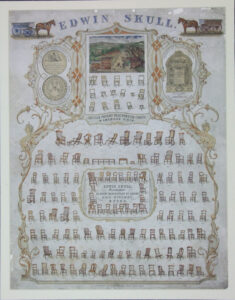
Advertising poster from Edwin Skull. Courtesy of Wycombe Museum
.
In the 1870s chairs from High Wycombe were supplied for the opening of the Royal Albert Hall and St Paul’s Cathedral. Then in 1875 an order was taken for 19,200 chairs to be delivered within a week to a meeting in London to be addressed by the great American evangelists Dwight Moody and Ira Sankey. And High Wycombe furniture makers met the deadline. At that time the collective output of the local area was put at 4,700 chairs per day (over 1.4 million per year) from 150 factories and workshops.
During the First and Second World Wars some of Wycombe’s furniture factories were also involved in making aircraft components. From 1942, the entire airframe of the *De Havilland Mosquito, a plane made of balsa/plywood and glued together was made in Wycombe factories. Fitted with twin Rolls-Royce Merlin engines, Mosquitos were the fastest and most advanced operational plane at that time and most were constructed in Wycombe and assembled the De Havilland factory in Hatfield. Initially they were used as photo reconnaissance planes and later as bombers and fighters too. In total some 7,781 Mosquitos were built, 5,000 of which the parts came from Wycombe.
(*Geoffrey de Havilland, aircraft designer/pioneer was born in Terriers House, opposite the Beech Tree pub, just one mile up the road towards Amersham, in 1882. Today the house has a grey plaque outside and is renamed De Havilland House.)
US General of the Air Force, Henry ‘Hap’ Arnold, witnessed trials of all the main RAF aircraft and had them tested against USAF planes. Some he thought impressive, others not so. But the Mosquito was deemed outstanding even outperforming anything in the US arsenal.
Wycombe Museum in Priory Avenue, HP13 6PX holds an extensive collection of locally made chairs and entry is FREE.