
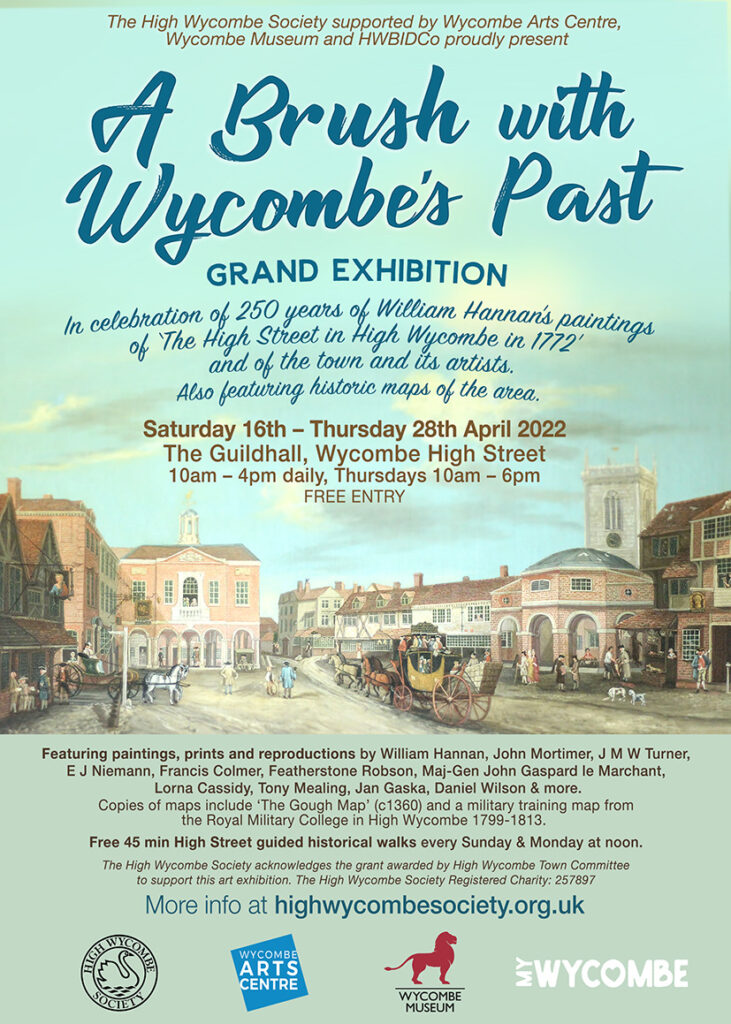
Members of the High Wycombe Society held a special Art Exhibition to be at High Wycombe’s Guildhall during April 2022. Dan Wilson designed a flyer for the event.
Entitled ‘A Brush with Wycombe’s Past’ the exhibition coincided with the 250-year anniversary of William Hannan’s two paintings of ‘The High Street in High Wycombe in 1772’ featured in recent editions of the Society’s Newsletter, and celebrated the town’s portrayal by local artists past and present. Alongside the artwork there was also a small exhibition featuring a number of historic maps of the area.
Art works, prints and reproductions featured included works by : William Hannan, John Mortimer, J M W Turner, E J Niemann, Francis Colmer, Featherstone Robson, Lorna Cassidy, Tony Mealing, Maj-Gen John Gaspard le Marchant, Jan Gaska and others.
Maps exhibited included copies of the Gough Map c1360 and a military training map from the Royal Military College in High Wycombe 1799-1813.
Willie Reid led 45 min guided historical walks leaving the art exhibition at 12 noon every Sunday and Monday.
The Society is pleased to be working with the Wycombe Arts Centre, Wycombe Museum and HWBidCo on this initiative. The High Wycombe Society also gratefully acknowledges the grant awarded by High Wycombe Town Committee to support this Art Exhibition.
Hot off the press, below is Dan’s flyer for the event.
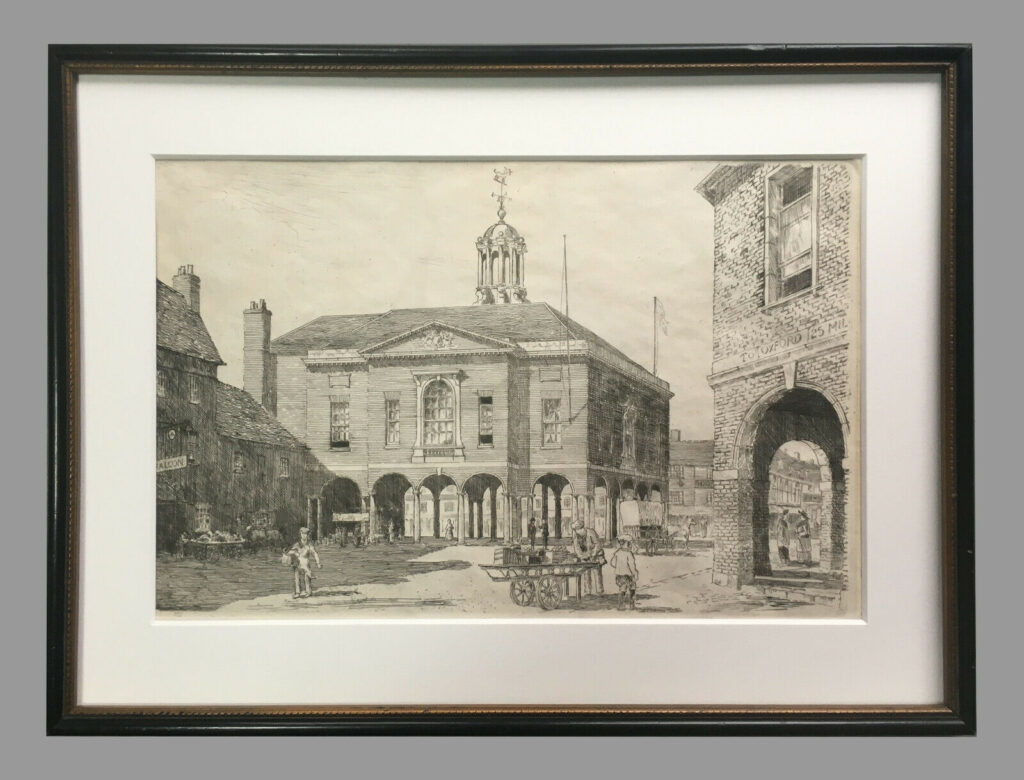
In the run-up to the exhibition, there will be a series of posts on social media giving 10 reasons to attend the exhibition. The first of these was posted to facebook on 6th April 2022, 10 days before the exhibition opening, and focused on the Guildhall as a building:
Only 10 days to go until we open up the Guildhall in High Wycombe to welcome people to our “Brush with Wycombe’s Past” exhibition. Ever since Lord Shelburne caused it to be built in 1757, this building has been a landmark in the centre of our town, serving first as the town hall and council chamber before newer buildings in Queen Victoria Road took over those functions in the twentieth century. A surprising number of local people today have never been inside, because it is generally kept locked except when in use for events or classes for which it has been hired out – if you’re curious to know what it’s like inside that may be reason enough for you to visit our exhibition between 16th April and 28th April. Admission is FREE – No need to book – All are welcome. Over the next few days we’ll be outlining more reasons to attend. The sketch of the Guildhall shown here is by R G Brocklehurst, a local artist in the mid-twentieth century, one of whose works (not this one) will feature in our exhibition.
Then on 7th April with 9 days to go:
With only 9 days to go before our “Brush with Wycombe’s Past” exhibition we’ve been giving some thought to the first and last things that visitors will see inside the building. On permanent display at the top of the main stairs in the Guildhall is a set of three large tapestries which were created to celebrate the Queen’s Golden Jubilee in 2002. One of the last things that visitors using the stairs will see is a stained glass window (pictured here), intended to serve as a thankful reminder to those Wycombe servicemen who returned home at the end of the First World War. Given to the town by Charles Raffety who had previously donated stained glass to the Town Hall. The stained glass was created in the studio of Arthur Dix.If you haven’t seen it at close quarters before that could be reason enough to visit our exhibition sometime between 16th and 28th April. Admission is FREE. #HWSArt2022

8th April post with 8 days to go:
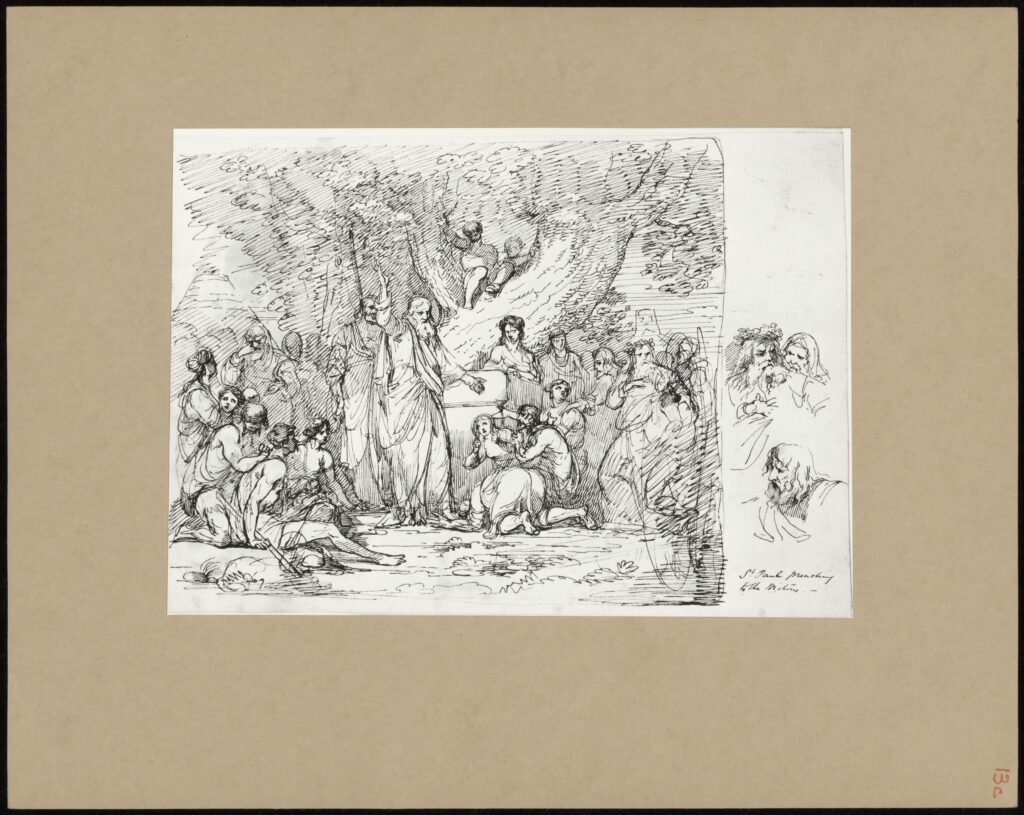
With 8 days to go until our “A Brush with Wycombe’s Past” exhibition, there’s one more item we should mention whose regular home is in the Shelburne room at the Guildhall although it wasn’t always so. The huge painting by John Hamilton Mortimer of St Paul preaching to the Ancient Britons at one time hung as an altarpiece in All Saints Parish Church. It was formally given by the church to the corporation (i.e. the town) of High Wycombe in 1872 when church alterations were made to accommodate the memorial window to Robert John Smith, the 2nd Lord Carrington. The painting was cleaned and re-varnished by a local portrait artist – Alfred Steers whose work included many portraits of local dignitaries of his time, and it was hung in the Guildhall when it also served as the Council Chamber. Pictured here is a sketch of the same scene as the painting. It is interesting to observe that John H Mortimer and William Hannan were contemporaries although the subject-matter of their paintings was very different.Our exhibition will celebrate the 250 year anniversary of William Hannan’s paintings of our High Street, but there’ll also be an opportunity to see John Mortimer’s painting. Reason #8 to attend. The exhibition runs from 16th to 28th April – Admission is FREE. #HWSArt2022
9th April post – 7 days to go:
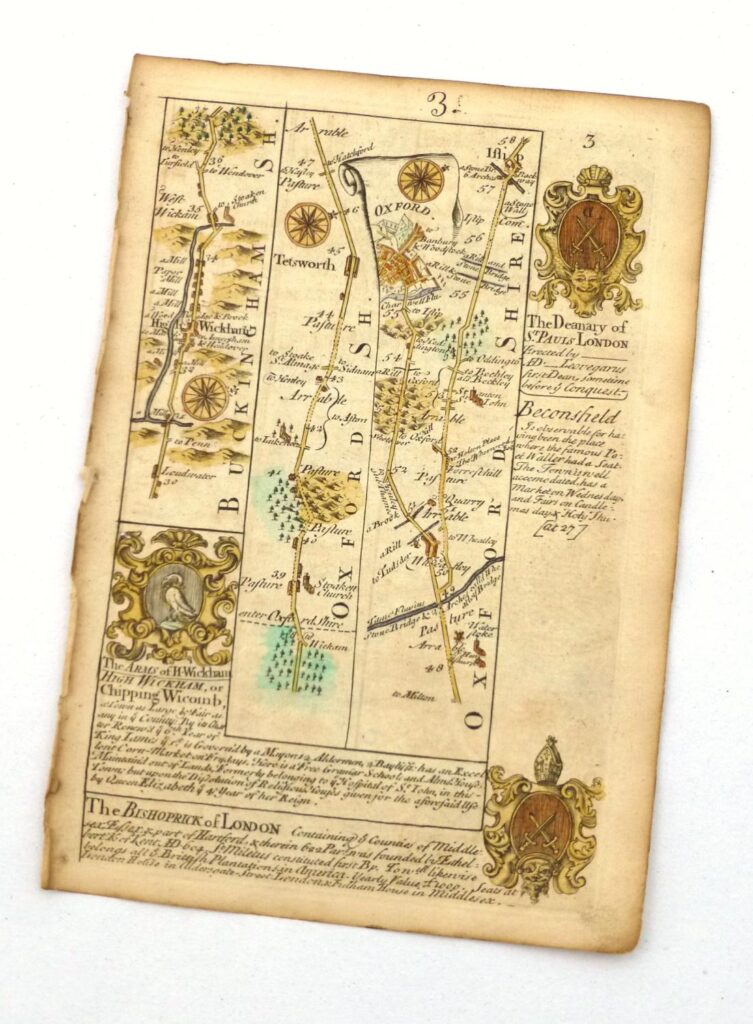
Many of you will have seen Mike Dewey’s Nostalgia column in the Bucks Free Press this week, featuring the watercolour painting by William Hannan of the High Street in High Wycombe in 1772 and the work that has been undertaken recently to confirm its authenticity. In our countdown to the Society’s exhibition which will celebrate the anniversary of this painting and another William Hannan picture of our High Street, with just seven days to go, we will turn our attention to another aspect of life in the eighteenth century which will also feature in our exhibition, the emergence of useful maps. Accustomed as we are nowadays to all the advantages of Satnav it is hard to realise what a luxury item any form of map still was then. There are some very early instances of Wycombe appearing on larger maps, but well-to-do travellers on stage-coaches passing through our town might at most have possessed pocket-atlases which gave them some idea of what to expect on their travels. Pictured here is one page of a 1753 edition of a map by Owen & Bowen which appeared in Britannica Depicta or Ogilvy Improv’d, one of the most popular atlases of the time.#HWSArt2022
10th April post- 6 days to go:
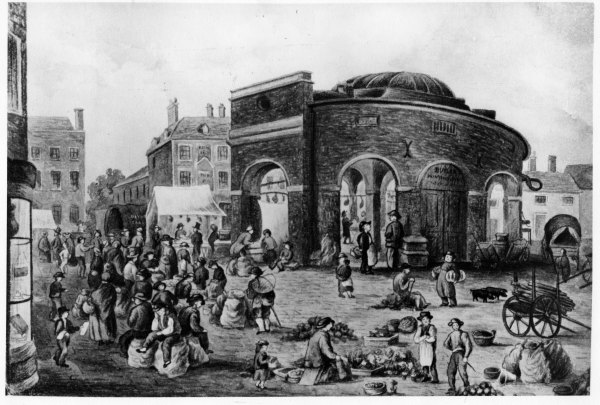
At around 10.30 tomorrow morning (Monday 11th April) Willie Reid, Society Trustee and organiser of the Society’s upcoming exhibition “A Brush with Wycombe’s Past” will be talking on Wycombe Sound radio. Please tune in if you can (or use Listen Again later). The exhibition which starts in 6 days time will feature reproductions of many paintings of our town centre produced over the 250 years since William Hannan’s striking pictures of the High Street – and will be accompanied by a collection of maps spanning a longer time period, from Wycombe’s first mention on a map through to the twentieth century. One period of particular interest in both categories is the beginning of the nineteenth century when High Wycombe was the location of the Royal Military College. Art was an important subject on the curriculum and if maps weren’t available they had to be drawn. Major-General Gaspard le Marchant was an accomplished artist and his legacy includes a number of paintings. But all officers needed to be able to sketch the terrain for military purposes and General Jarry gave classes in how to do so speedily. When Howard Douglas arrived on the scene he advocated more military surveying techniques making greater use of technical instruments to achieve accuracy. One sketch which was allegedly made by a student at the RMC is this curious picture of the Little Market House in High Wycombe. This image is from the SWOP collection ref. RHW: 08006 courtesy of Wycombe library, but no-one seems to know any more about it. It didn’t make it to the final cut of exhibits but one can’t help wondering if there is a painting out there to which it relates.#HWSArt2022
11th April post – 5 days to go:
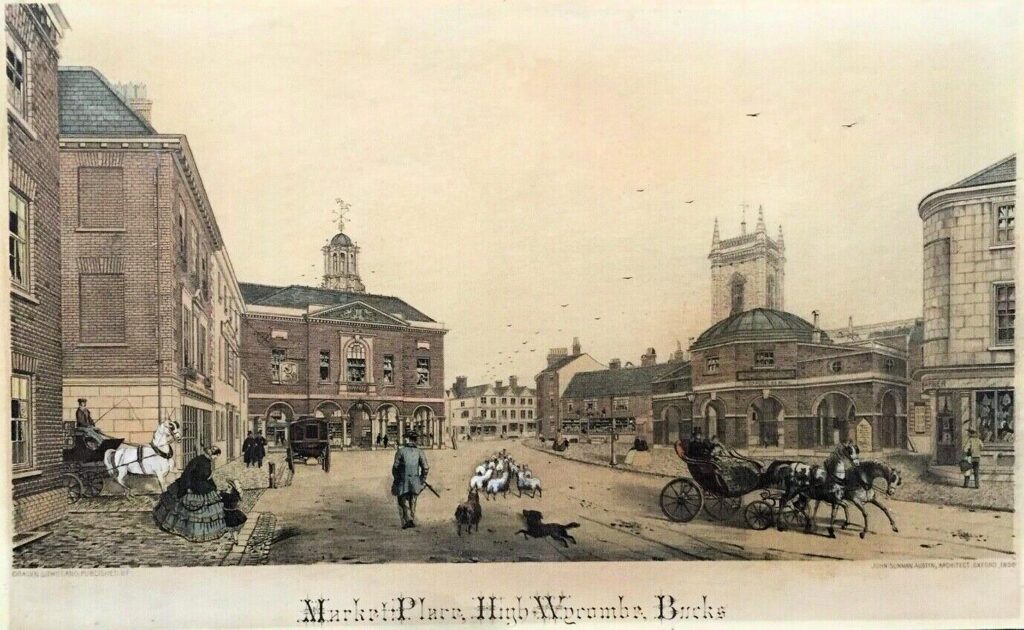
At a little under 5 days to go until our exhibition it’s time to think about how things changed in High Wycombe in the middle of the nineteenth century and how that is reflected in the art and maps of the time. When E J Niemann “gave up his day job” to focus on his art, at the age of 26, he left London and settled in High Wycombe. His painting of our High Street is on permanent display at Wycombe Museum. It and other illustrations were engraved and reproduced widely. A lesser-known lithograph from 1852 shown here was produced by an architect, John Sunman Austin, and a limited number of prints were sold. He was not a local man. Towards the end of his life, already in ill-health, he had moved from Bedford to Oxford. A few years later a big change to the town was brought about by the arrival of the railway, and it is fitting that there should be a “corner” in our exhibition with a railway-related theme. There were many different plans for expansion of the railway network, most of which did not come to fruition. Fancy getting on the train from High Wycombe to Great Missenden, anyone?Towards the end of the century we begin to see reports in the local press about art exhibitions featuring work by local artists including several ladies of leisure who were encouraged to follow gentle pursuits.The Society’s exhibition “A Brush with Wycombe’s Past” takes place from 16th to 28th April in the Guildhall in the High Street. Open Daily 10-4 (10-6 on Thursdays). Admission Free. #HWSArt2022
12th April Post – 4 days to go
With only 4 days to go until our “A Brush with Wycombe’s past” exhibition, we need at least to dip into the twentieth century. It began well with the newly founded Technical & Arts school in Frogmoor which would later move to the old Grammar school site in Easton Street. Walter J Stamps who was its Head for a while painted many scenes within the town. But when it comes to documenting our town’s history visually, few artists rival Francis Colmer. You can see reproduced examples of his paintings on information boards that the Society has installed near the site of Bridge Mill in Pauls Row and more recently on the site of the Black Boy pub in Church Street. The Discover Bucks museum in Aylesbury holds over 100 of his watercolours which can be seen at Halton by appointment. The Society had a group visit a few years ago to see them. A few of his oil paintings are also to be found at Wycombe Museum. And to the delight of local historians, Colmer wrote about each painting on its reverse although his handwriting often leaves a bit to be desired. The mid-twentieth century saw a very active Arts Association take on many roles within the town including some we would call “heritage” today. It was thanks to one active member, Lorna Cassidy, that we have a visual record of a crucial meeting held in the Guildhall in 1968 at which they decided that civic matters could be better handled by a separate organisation and lent their support to the founding of the High Wycombe Society. In the early days of the Society there were several talented artists who contributed to our publications – some of whose work will be on display at the Society’s exhibition. Eric Fowler’s legacy included some simple sketches of popular scenes like the one seen here of the guildhall which were subsequently made into notelets. They have been sold ever since at Pann Mill Open Days and at society meetings. It is only relatively recently that we have been made aware of some of his paintings. The Exhibition at the Guildhall in High Wycombe will be open daily from 16th to 28th April from 10am to 4pm (with an extra 2 hours late opening on Thursdays) #HWSArt2022

13th April Post – 3 days to go
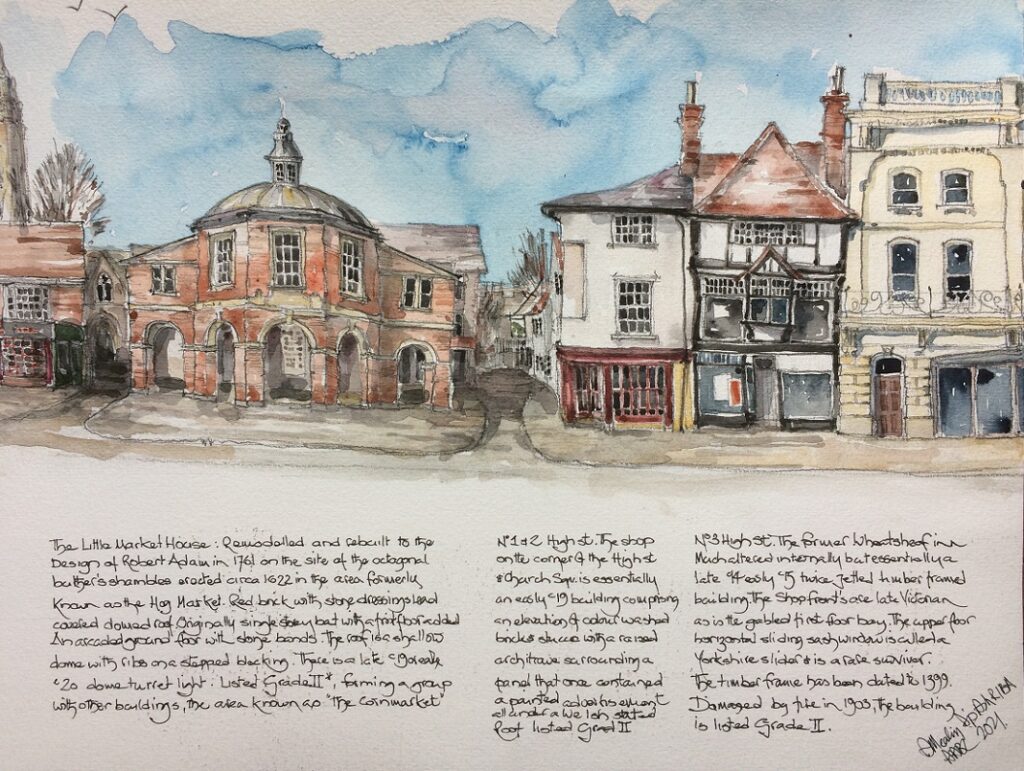
As we continue our countdown to “A Brush with Wycombe’s Past”, the Society’s exhibition which starts on Saturday 16th April in the Guildhall, High Wycombe, it’s time to acknowledge some of the artists practising in our Town today. Two individuals have made special contributions to our Exhibition which charts the portrayal of our Town Centre over 250 years. Both are regular users of facebook. Jan Gaska is often to be seen about town with his easel working in plein air and regularly delights his fans on facebook with images of his latest efforts. He has kept under wraps a contribution to our exhibition. Meanwhile, some of you may remember in October 2021 seeing for the first time a frieze of watercolour paintings of the buildings of the North side of the High Street by our resident conservation architect, Tony Mealing. 2022 has seen him complete a similar panoramic view of the South side of the High Street. Both views are accompanied by notes highlighting the architectural features of the buildings which Tony is well-qualified to identify. Visitors will have an opportunity to order prints of these friezes at the exhibition. Tony is not the first to attempt the feat of capturing the architectural details. As a Society, we recently received a donation of some sketches from the 1960s by an early member of the Society, Derek Woods. There are some more examples of his work in the Green Collection in High Wycombe library and it is an interesting exercise to look at what has changed. The picture with this post, however, is a taster of Tony Mealing’s work, the Western end of the Northern side of the High Street. By the time Tony completed this work last year, the timbered building portrayed, once known as the Wheatsheaf, was already shrouded in scaffolding undergoing major restoration work. – just one example of our ever-changing High Street. If you’d like to see the whole friezes then be sure to put “A Brush with Wycombe’s Past” into your diary. It’s open daily from 10 am until 4 pm (with late opening until 6 pm on Thursdays) – starting this Saturday 16th April and ending on Thursday 28th April. #HWSArt2022
Today work begins at the Guildhall in High Wycombe to prepare for our much anticipated Exhibition “A Brush with Wycombe’s Past”. It’s a while since there’s been an art exhibition there and sturdy boards need to be brought in on which to hang a number of the items. Star items at the exhibition will be reproductions of the two paintings by William Hannan of the High Street in 1772: the first, originally a watercolour, from which engravings have been made in the past. The search to locate the original featured in last week’s Bucks Free Press. The second is less well-known as it has been in private ownership and only occasionally exhibited. It shares many features with the first, but, being an oil painting is much richer in colour – and the view being much closer to the main buildings of the Guildhall and Little Market House means that there are many more details for the local history enthusiast to observe: the Maidenhead Inn is clearly depicted on the South side of the High Street – while Daniel Heading’s boast that he can offer tea as cheap as any in London, can be read above his shop in the Cornmarket. Many of the characters appear in both paintings and there is a narrative believed to be contemporary which identifies many of them.If you haven’t already done so, please put our Exhibition in your diary. It’s FREE to attend. Open daily 10-4 from Saturday 16th April until Thursday 28th April (and 10-6 on Thursdays). The flyer here was designed by Dan Wilson based on the scene depicted in the oil painting and is a work of art in itself! Over the past few days we’ve previewed some but not all of the other items that will be on display. There are many reasons to visit – and we look forward to welcoming you when you do!